In distributed architectures, fan-out is the core design pattern used to decouple a single event producer from multiple downstream processing pipelines. Whether you are broadcasting order creation events, handling real-time social feed ingestion, or triggering parallel audit logs, fan-out guarantees that a single write can trigger independent asynchronous operations concurrently.
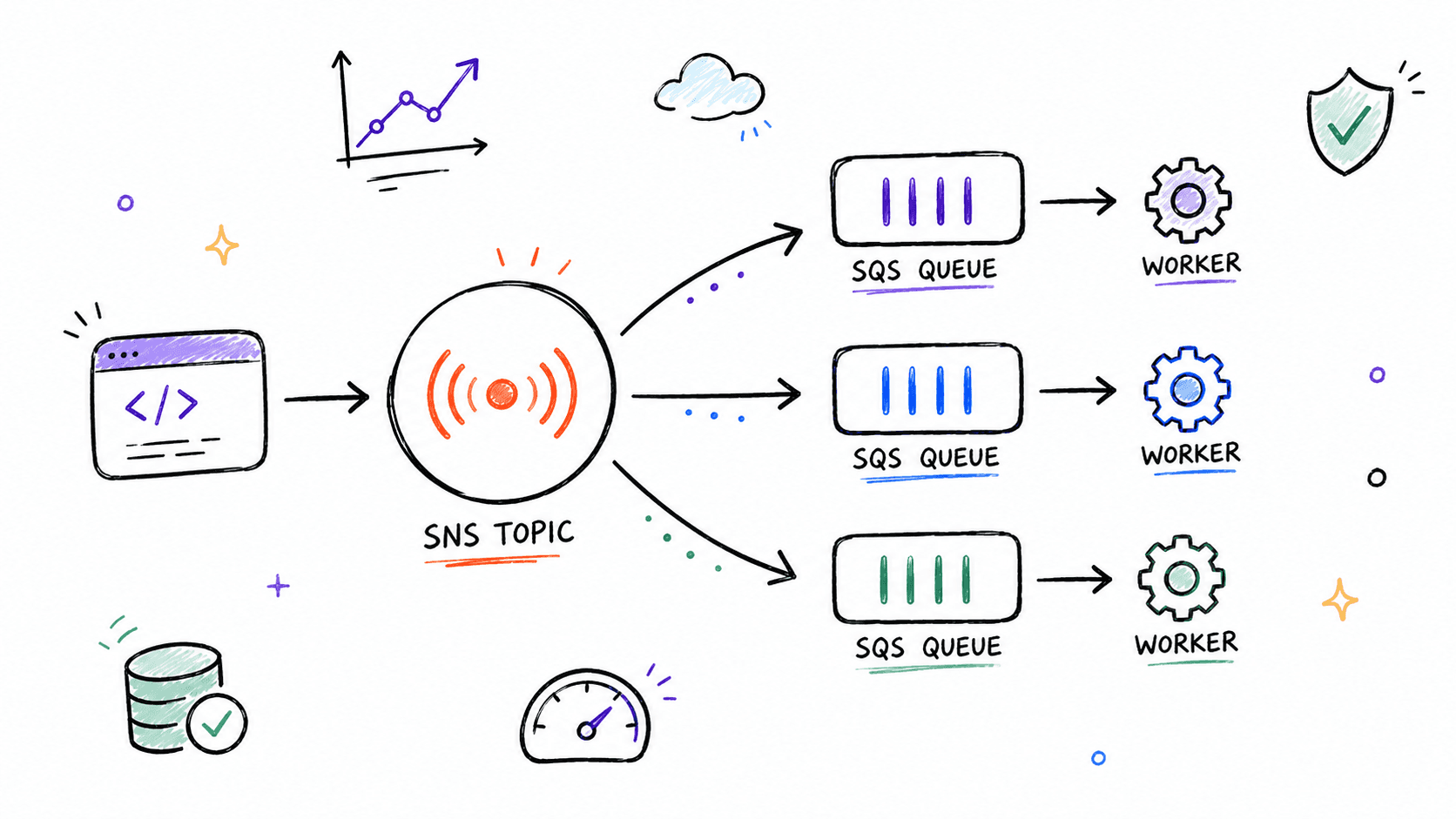
1. System Topology: SNS to SQS Distributed Fan-Out
2. Architectural Comparison: Fan-Out on Write vs. Fan-Out on Read
Selecting the wrong fan-out strategy is one of the most common causes of cascading database failures under traffic spikes.
Fan-Out on Write (Push Model)
When an event occurs, the producer (or dispatcher) immediately broadcasts the payload to every subscriber's queue. Each worker materializes the result into localized storage.
- Pros: Read requests are near-instant ( lookup time) because data is pre-computed.
- Cons: Write amplification ( writes for subscribers). High-cardinality producers (e.g. users with millions of followers) create extreme write spikes.
Fan-Out on Read (Pull Model)
Events are recorded into a centralized append-only log. Downstream services fetch and aggregate data only when a read request is received.
- Pros: Write phase is extremely fast ( append).
- Cons: High read latency ( query cost to aggregate sources at query time).
| Metric / Dimension | Fan-Out on Write (Push) | Fan-Out on Read (Pull) |
|---|---|---|
| Write Complexity | write amplification | single append |
| Read Latency | ⚡ (Pre-computed) | 🐢 (On-demand joins) |
| Storage Overhead | High (Duplicated per consumer) | Low (Single log record) |
| Failure Isolation | High (Isolated consumer queues) | Medium (Shared read bottleneck) |
| Best For | E-commerce orders, Billing, Notifications | High-fanout social feeds (Celebrity problem) |
3. Mathematical Model of Buffer Capacity & Consumer Scale
To prevent message loss during burst traffic, queue depth is governed by the rate of producer emission minus total worker consumption capacity:
Where:
- is the incoming message rate per second.
- is the processing capacity of a single worker instance ().
- is the current auto-scaled worker count.
If , the queue buffers messages without dropping requests. To prevent infinite memory growth, visibility timeouts and Dead Letter Queues (DLQs) isolate poison-pill messages after failed retries.
4. Implementing Idempotent Fan-Out Dispatchers
Because message queues guarantee at-least-once delivery, workers MUST be strictly idempotent. Below are production implementations in TypeScript, Python, and Go:
1import { SNSClient, PublishCommand } from "@aws-sdk/client-sns";2import { SQSClient, ReceiveMessageCommand, DeleteMessageCommand } from "@aws-sdk/client-sqs";3import { Redis } from "ioredis";45const sns = new SNSClient({ region: "us-east-1" });6const redis = new Redis(process.env.REDIS_URL!);78export interface OrderEvent {9 eventId: string;10 orderId: string;11 amount: number;12 currency: string;13 timestamp: string;14}1516// 1. Publish Event to Fan-Out Topic17export async function publishOrderEvent(event: OrderEvent, topicArn: string): Promise<string> {18 const command = new PublishCommand({19 TopicArn: topicArn,20 Message: JSON.stringify(event),21 MessageDeduplicationId: event.eventId,22 MessageGroupId: event.orderId,23 });2425 const response = await sns.send(command);26 return response.MessageId!;27}2829// 2. Idempotent Consumer Worker with Redis Deduplication30export async function processBillingQueueMessage(message: { Body?: string; ReceiptHandle?: string }): Promise<void> {31 if (!message.Body) return;3233 const event: OrderEvent = JSON.parse(message.Body);34 const lockKey = `idempotency:billing:${event.eventId}`;3536 // Atomic SETNX (Set if Not Exists) with 24h TTL37 const acquired = await redis.set(lockKey, "PROCESSING", "EX", 86400, "NX");3839 if (!acquired) {40 console.log(`[Idempotency] Event ${event.eventId} already processed or in-flight. Skipping.`);41 return;42 }4344 try {45 // Process payment transaction46 await executePaymentCharge(event);47 await redis.set(lockKey, "COMPLETED", "EX", 86400);48 } catch (err) {49 await redis.del(lockKey); // Release lock for retry50 throw err;51 }52}5354async function executePaymentCharge(event: OrderEvent): Promise<void> {55 // Payment gateway logic...56}
5. Key Resilience Principles
- Dead Letter Queue (DLQ) Isolation: Route poison-pill messages to a DLQ after consecutive failures to prevent blocking worker pools.
- Exponential Backoff with Jitter: Avoid thundering herd problems on downstream databases when recovering from an outage:
- Idempotency Key Enforcement: Store processed message IDs in Redis or Postgres with TTL to prevent duplicate execution during network retries.