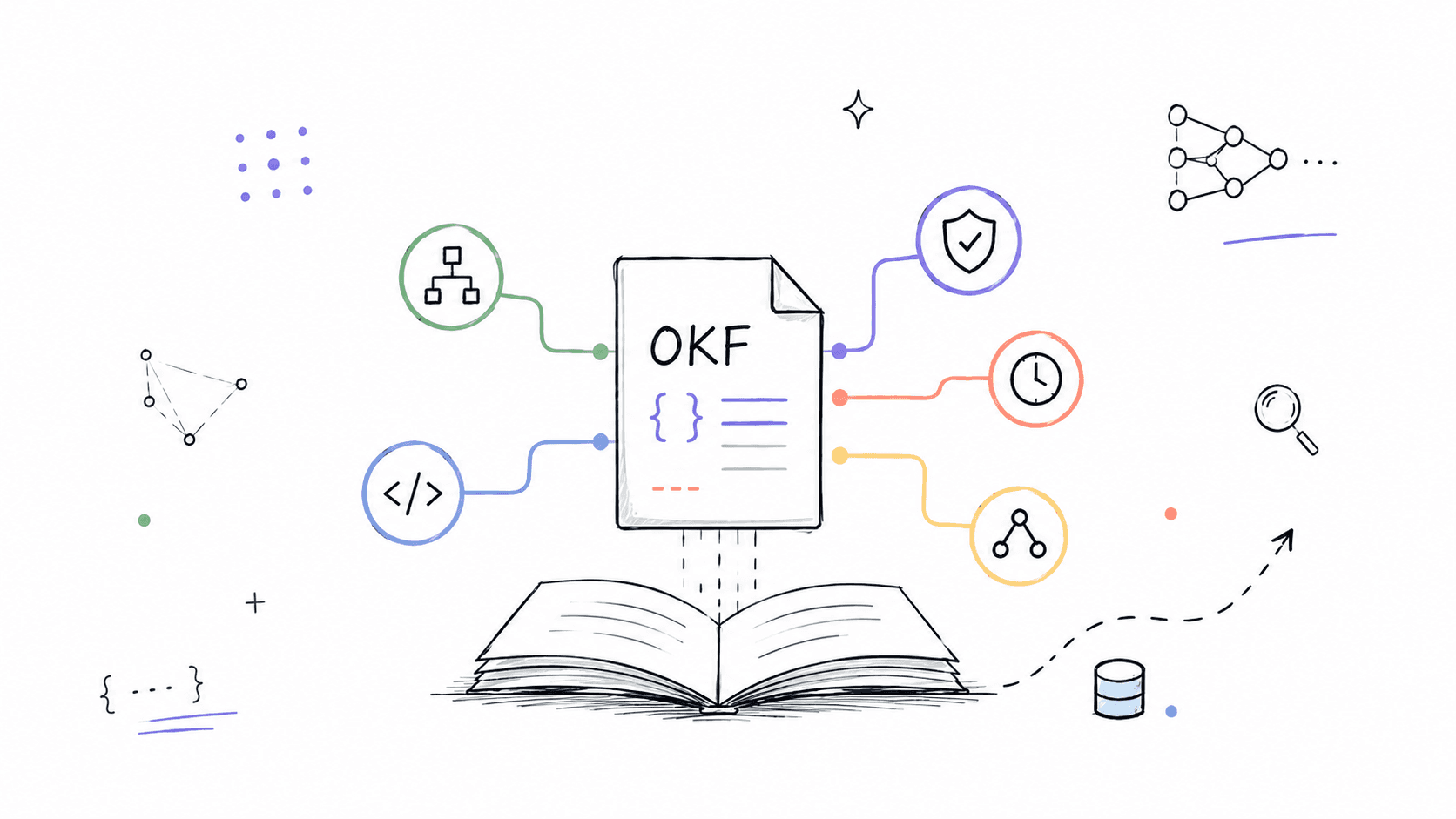
"Documentation is no longer merely an archive for human memory; it is the runtime executable memory of the autonomous enterprise."
As autonomous AI agents transition from standalone chat interfaces into persistent coworkers that debug code, triage infrastructure outages, and synthesize legal contracts, a glaring architectural vulnerability has emerged: the Context Assembly Crisis.
For the past three years, the industry leaned heavily on Retrieval-Augmented Generation (RAG). We converted documents into arbitrary 512-token chunks, projected them into high-dimensional vector spaces, and queried them via cosine similarity.
While vector RAG works reasonably well for fuzzy topic lookups, it fails catastrophically when an AI agent requires relational precision, deterministic multi-hop traversal, or temporal validity.
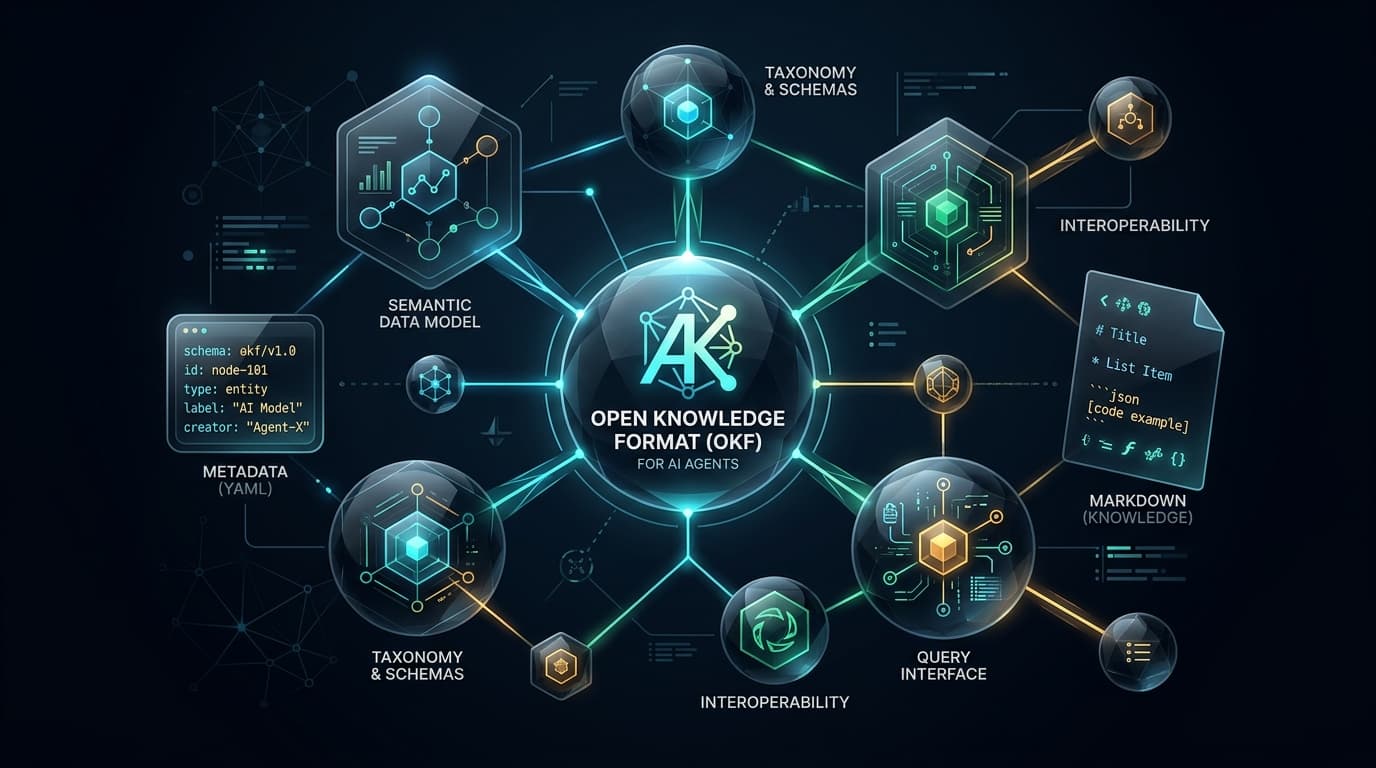
Enter the Open Knowledge Format (OKF): a vendor-neutral, open specification introduced to standardize how institutional knowledge is structured, interlinked, verified, and consumed by both human engineers and AI agents.
1. The Context Assembly Crisis
To understand why OKF is necessary, consider how a human engineer vs. a naive RAG agent answers a nuanced enterprise question:
"What is our automated refund ceiling for Tier-2 European enterprise customers under the 2026 GDPR-compliant billing policy revision?"
In a traditional vector database:
- The question is converted to an embedding vector .
- Top- chunks are retrieved based on vector cosine proximity:
- The retriever fetches chunks discussing "Refunds", "Tier-2 customers", and "2024 billing guidelines".
- The system fails to retrieve the critical one-line addendum stored in a different folder that superseded the 2024 policy with the 2026 revision.
- The LLM produces a confident, plausible, yet legally non-compliant hallucination.
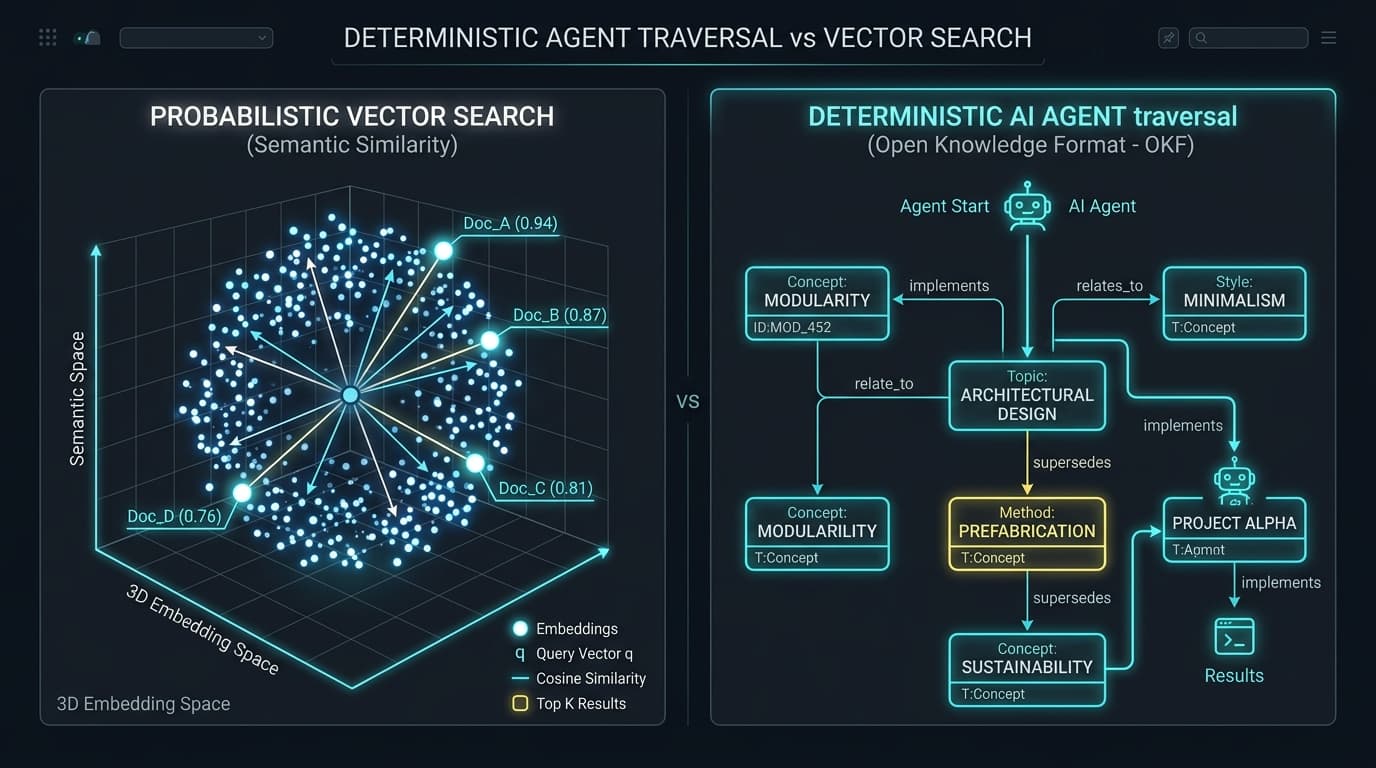
Vector embeddings capture semantic proximity, not logical causality, hierarchical inheritance, or temporal invalidation. An outdated document and an active document discussing the same topic occupy almost identical coordinates in vector space.
The Core Failure Modes of Chunk-Based RAG
- Fragmented Context: Arbitrary token boundaries slice through code blocks, tables, and conditional logic clauses.
- Lost In The Middle: Stuffing 30 noisy chunks into a 128k context window degrades reasoning density.
- Zero Invalidation Graph: When Policy B deprecates Policy A, vector search continues to return Policy A with high confidence scores.
- Unstructured Multi-Hop Failures: Agents cannot deterministically jump from an Entity SLO Metric Runbook without hallucinating connection paths.
2. What is Open Knowledge Format (OKF)?
Open Knowledge Format (OKF) is a file-native, human-readable, and machine-verifiable specification. Rather than introducing another proprietary graph database or SaaS API, OKF establishes an open standard built directly on top of ubiquitous foundational formats: Markdown and Schema-Validated YAML.
The "Format, Not a Service" Philosophy
- Git-Native & Version-Controlled: Knowledge lives in your repository alongside code, governed by pull requests and code reviews.
- Zero Runtime Vendor Lock-in: Usable by any LLM, local agent (e.g. Ollama, Claude, Gemini, GPT-4), or static site generator.
- Dual-Consumer Design: A human reads the Markdown body effortlessly in VS Code or Obsidian; an AI agent parses the YAML frontmatter to construct a high-fidelity knowledge graph.
3. Anatomy of an OKF Knowledge Node
Every document in an OKF repository is a self-contained node representing a discrete unit of institutional intelligence (a concept, architecture decision, operational policy, metric definition, or incident runbook).
Here is a complete specification example of an OKF node (policy-refund-eu-tier2.okf.md):
1---2okf_version: "1.0"3id: "POL-BILLING-2026-EU-02"4type: "policy"5title: "Tier-2 Enterprise Refund & Credit Allocation Policy (EU Region)"6status: "active"7version: "2.1.0"8created_at: "2026-01-15T08:00:00Z"9updated_at: "2026-06-20T14:30:00Z"1011authors:12 - name: "Ayush Singh"13 role: "Staff Infrastructure Architect"14 id: "eng_ayush"1516trust:17 verification_level: "cryptographically_signed"18 verified_by: "finance-compliance-bot@corp.internal"19 confidence_score: 0.9920 ttl_days: 902122relations:23 implements:24 - "REG-GDPR-ART-17"25 - "COMPLIANCE-EU-FIN-2026"26 supersedes:27 - "POL-BILLING-2024-EU-01"28 depends_on:29 - "SYS-BILLING-SERVICE-V3"30 - "METRIC-SLA-MONTHLY-UPTIME"31 conflicts_with: []32 relates_to:33 - "RUNBOOK-DISPUTE-RESOLUTION"3435parameters:36 max_automated_credit_eur: 1500037 approval_threshold_eur: 5000038 escalation_target: "finance-oncall"39 currency: "EUR"40 applicable_regions: ["FRA", "DUB", "AMS", "BER"]4142tags:43 - "Billing"44 - "Compliance"45 - "EU"46 - "Enterprise"47---4849# Tier-2 Enterprise Refund & Credit Allocation Policy5051This document governs the automated and manual disbursement of credits and refunds for Enterprise Tier-2 customers operating within the European Economic Area.5253## 1. Automated Disbursement Thresholds5455Under contract revision 2026-Q1, automated credit adjustments are executed if the measured service availability falls below SLA limits:5657$$C_{\text{credit}} = \min\left( \Delta_{\text{downtime}} \times R_{\text{tier2}}, \; 15000\text{ EUR} \right)$$5859Where:60- $\Delta_{\text{downtime}}$ represents verified outage minutes exceeding the 99.95% availability threshold.61- $R_{\text{tier2}}$ is the hourly SLA penalty factor (€250/hr).6263## 2. Escalation Workflow6465Any credit claim exceeding **€15,000** must halt automated execution and trigger an escalation ticket to `finance-oncall` with attached telemetry proofs from `SYS-BILLING-SERVICE-V3`.
4. OKF Node Taxonomies & Relation Types
OKF categorizes organizational knowledge into canonical archetypes to prevent ambiguity:
| Node Type | Primary Objective | Key YAML Attributes |
|---|---|---|
policy | Business rules, compliance requirements, security boundaries | parameters, enforcement_level, applicable_regions |
runbook | Step-by-step remediation procedures for alerts | trigger_alerts, prerequisites, rollback_steps |
architecture_decision | ADRs detailing system design and technical trade-offs | status, deciders, options_considered, consequences |
metric | Single source of truth for calculations and telemetry | formula, source_telemetry, slo_target |
concept | Foundational terminology and domain models | aliases, formal_definition, examples |
entity | Systems, microservices, databases, vendors | owner_team, repo_url, health_check_endpoint |
5. Deterministic Traversal vs. Stochastic Similarity
When an AI agent is equipped with an OKF-aware toolset, it does not guess which documents to retrieve using cosine distance alone. Instead, it combines semantic seeding with deterministic graph navigation:
1[User Query]2 │3 ▼4[Step 1: Seed Lookup] ──> Match seed node via Vector / Keyword (POL-BILLING-2026-EU-02)5 │6 ▼7[Step 2: Relation Expansion] ──> Follow typed edges:8 ├── `implements` ──> REG-GDPR-ART-179 ├── `supersedes` ──> POL-BILLING-2024-EU-01 (Flagged as EXCLUDED / STALE)10 └── `depends_on` ──> METRIC-SLA-MONTHLY-UPTIME11 │12 ▼13[Step 3: Graph Filter & Pruning] ──> Strip stale nodes, verify TTL & signatures14 │15 ▼16[Step 4: Context Assembly] ──> Inject clean, structured knowledge tree into LLM Context
This ensures:
- Zero Outdated Policies: The agent actively drops
POL-BILLING-2024-EU-01because it detects thesupersedeslink. - Explicit Verification: If an OKF node has passed its
ttl_dayswithout re-attestation, the agent flags it as"potentially stale"in its reasoning trace. - Exact Parametric Reasoning: Values like
max_automated_credit_eur: 15000are extracted directly from YAML parameters rather than parsed loosely from prose.
6. Comprehensive Architectural Comparison
| Dimension | Vector RAG (Pinecone / Qdrant) | Enterprise Wikis (Confluence / Notion) | Graph DBs (Neo4j / RDF) | Open Knowledge Format (OKF) |
|---|---|---|---|---|
| Storage Medium | Proprietary Vector Indices | Proprietary Cloud Database | Property Graph Engine | Plain Markdown + YAML in Git |
| Human Readability | ❌ None (Vectors / Floats) | ✅ High (Rich UI) | ⚠️ Moderate (Cypher queries) | ✅ High (Standard Markdown) |
| AI Agent Navigation | ⚠️ Stochastic (Top-K) | ❌ Poor (HTML/REST scraping) | ✅ High (Graph Traversal) | ✅ High (Deterministic Graph) |
| Version Control | ❌ Complex / Async | ⚠️ Weak page history | ⚠️ Database backups | ✅ Native Git (PRs, Diffs, Blame) |
| Temporal Freshness | ❌ Blind to deprecation | ⚠️ Manual review | ⚠️ Schema triggers | ✅ Built-in TTL & Invalidation edges |
| Cost & Portability | 💸 Recurring infra cost | 💸 SaaS subscription | 💸 Database instances | ⚡ Free, Zero-Infrastructure |
6. Code Migration: Vector RAG to OKF Graph Traversal
Notice how migrating from stochastic vector similarity to deterministic OKF graph traversal eliminates arbitrary chunking and stale policy leakage:
-- // 1. STOCHASTIC VECTOR RAG (Prone to stale policies and chunk fragmentation)-- const queryEmbedding = await embedder.createEmbedding(userQuery);-- const noisyChunks = await vectorDb.similaritySearch({-- vector: queryEmbedding,-- topK: 8,-- minScore: 0.72,-- });-- // Concatenates fragmented chunks without knowing if POL-2024 was superseded-- const promptContext = noisyChunks.map((chunk) => chunk.pageContent).join("\n---\n");10++ // 2. DETERMINISTIC OKF TRAVERSAL (Strict schema validation + typed relation crawl)++ const seedId = await okfRepo.resolveSeedEntity(userQuery);++ const verifiedNodes = okfRepo.getRelatedContext(seedId, {++ maxDepth: 2,++ filterSuperseded: true,++ requireActiveTTL: true,++ });++ // Injects structured YAML parameters and validated markdown context++ const promptContext = verifiedNodes.map((n) => n.toAgentContext()).join("\n\n");
7. Implementing OKF in Multiple Languages
Because OKF is a vendor-neutral standard based on Markdown and YAML, engineers can implement the parsing and graph traversal pipeline in any language:
1import fs from "fs";2import path from "path";3import matter from "gray-matter";4import { z } from "zod";56// 1. Define OKF Frontmatter Schema7export const OKFNodeSchema = z.object({8 okf_version: z.literal("1.0"),9 id: z.string(),10 type: z.enum(["concept", "policy", "metric", "runbook", "architecture_decision", "entity"]),11 title: z.string(),12 status: z.enum(["draft", "active", "deprecated", "superseded"]),13 version: z.string(),14 created_at: z.string(),15 updated_at: z.string(),16 trust: z.object({17 verification_level: z.string(),18 verified_by: z.string(),19 confidence_score: z.number().min(0).max(1),20 ttl_days: z.number().positive(),21 }),22 relations: z.object({23 implements: z.array(z.string()).default([]),24 supersedes: z.array(z.string()).default([]),25 depends_on: z.array(z.string()).default([]),26 conflicts_with: z.array(z.string()).default([]),27 relates_to: z.array(z.string()).default([]),28 }),29 parameters: z.record(z.any()).optional(),30 tags: z.array(z.string()).default([]),31});3233export type OKFNode = z.infer<typeof OKFNodeSchema> & {34 content: string;35 filePath: string;36};3738// 2. Load & Validate an OKF Repository39export class OKFRepository {40 private nodes: Map<string, OKFNode> = new Map();4142 public loadDirectory(dirPath: string): void {43 const files = fs.readdirSync(dirPath, { recursive: true }) as string[];4445 for (const file of files) {46 if (!file.endsWith(".okf.md") && !file.endsWith(".md")) continue;4748 const fullPath = path.join(dirPath, file);49 const raw = fs.readFileSync(fullPath, "utf-8");50 const { data, content } = matter(raw);5152 const parsedMeta = OKFNodeSchema.safeParse(data);53 if (parsedMeta.success) {54 this.nodes.set(parsedMeta.data.id, {55 ...parsedMeta.data,56 content,57 filePath: fullPath,58 });59 }60 }61 }6263 // 3. Deterministic Multi-Hop Traversal64 public getRelatedContext(nodeId: string, depth = 1): OKFNode[] {65 const root = this.nodes.get(nodeId);66 if (!root) return [];6768 const visited = new Set<string>([nodeId]);69 const results: OKFNode[] = [root];7071 const traverse = (currentId: string, currentDepth: number) => {72 if (currentDepth > depth) return;73 const node = this.nodes.get(currentId);74 if (!node) return;7576 const neighborIds = [77 ...node.relations.depends_on,78 ...node.relations.implements,79 ...node.relations.relates_to,80 ];8182 for (const nId of neighborIds) {83 if (!visited.has(nId) && this.nodes.has(nId)) {84 visited.add(nId);85 const neighbor = this.nodes.get(nId)!;86 // Filter out deprecated or superseded nodes87 if (neighbor.status === "active") {88 results.push(neighbor);89 traverse(nId, currentDepth + 1);90 }91 }92 }93 };9495 traverse(nodeId, 1);96 return results;97 }98}
8. Continuous Knowledge Integration (CKI)
Just as Continuous Integration (CI) revolutionized software engineering by preventing compilation failures, OKF enables Continuous Knowledge Integration (CKI) in your build pipelines.
A standard CKI GitHub Action validates your knowledge base on every commit:
- Orphan Link Detection: Alerts if a node's
depends_onorsupersedesID does not exist. - Circular Invalidation Check: Prevents Node A from superseding Node B while Node B supersedes Node A.
- Staleness Alarm: Automatically creates a GitHub issue if a node's last
verified_bydate exceeds itsttl_days. - Agent Schema Compliance: Validates that all critical enterprise metrics contain executable formulas and telemetry data paths.
9. Conclusion: The Knowledge Protocol for the Agentic Era
As we build autonomous agent swarms capable of self-directed research, architecture design, and system operations, our documentation layer must evolve from static text dumps into rigorous, executable, and interconnected semantic substrates.
The Open Knowledge Format (OKF) represents this crucial paradigm shift. By marrying the simplicity and human ergonomics of Markdown with the deterministic precision of schema-validated graph metadata, OKF lays the groundwork for an open, vendor-neutral future where humans and AI agents share a unified source of truth.
Further Reading & Resources
Hover over any of the reference links below to inspect the cursor-following OpenGraph preview:
- Next.js App Router Documentation — Modern React framework powering high-performance static and dynamic web experiences.
- GitHub Actions & Workflow Automation — Continuous integration and automated knowledge graph validation pipelines.
- OpenAI Platform & Function Calling Guide — Foundational model API architecture and structured schema validation.
- Qdrant Vector Database Architecture — High-dimensional vector search engine and RAG storage layers.