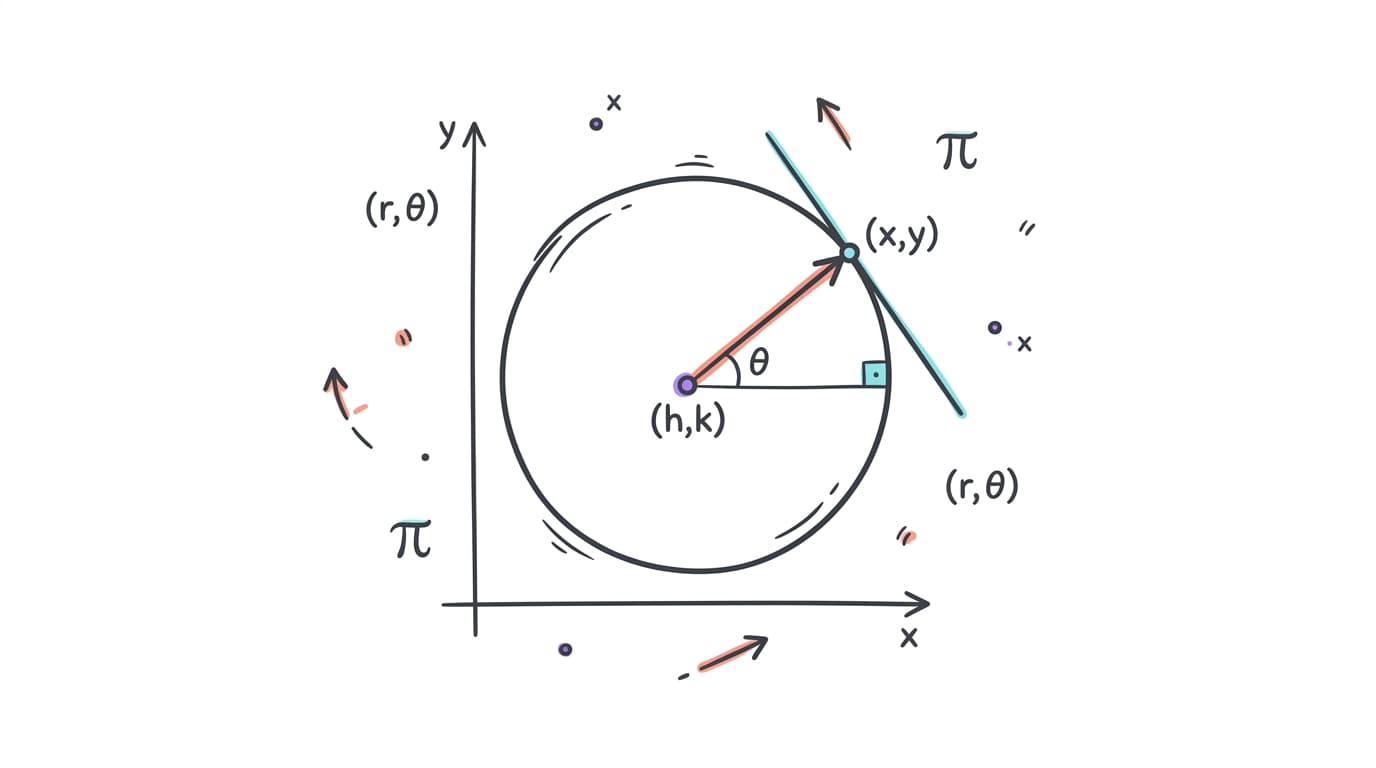
A circle is defined algebraically as the locus of all points in a 2D Euclidean plane that maintain a constant distance—termed the radius (r)—from a fixed reference point known as the center(h,k).
From the Pythagorean distance formula between center (h,k) and any boundary point (x,y):
(x−h)2+(y−k)2=r2
When centered at the origin (0,0), this simplifies to the unit canonical form:
x2+y2=r2
General Second-Degree Equation
Expanding the standard form yields the general second-degree equation of a conic section:
x2+y2+2gx+2fy+c=0
Where the geometric parameters are extracted via complete-the-square operations:
Center Coordinates: (h,k)=(−g,−f)
Radius Value: r=g2+f2−c
Condition for real circles: g2+f2−c>0. If equal to 0, the circle degenerates to a single point (−g,−f).
2. Interactive Geometry Visualizer: Parametric & Tangent Point Inspection
Below is an interactive mathematical canvas representing the circle geometry. Use the sliders to manipulate the radius r and subtended angle θ to dynamically observe parametric coordinates, tangent slope vectors, arc length, and surface area:
Radius (r):3.00 units
Angle (θ):45° (0.79 rad)
Standard Form(x-h)² + (y-k)² = r²
Arc Length (S)2.36 units
Area (π·r²)28.27 sq units
Circumference (2π·r)18.85 units
3. Parametric Equations & Vector Trajectories
Instead of implicit Cartesian bounds, parametric equations represent boundary coordinates (x(θ),y(θ)) as continuous functions of a angular parameter θ∈[0,2π):
{x(θ)=h+rcosθy(θ)=k+rsinθ
Vector Velocity & Tangent Lines
Differentiating the parametric position vector r(θ)=⟨h+rcosθ,k+rsinθ⟩ with respect to parameter θ:
v(θ)=dθdr=⟨−rsinθ,rcosθ⟩
Notice that the dot product of the radius vector u=⟨rcosθ,rsinθ⟩ and velocity vector v equals zero:
u⋅v=(rcosθ)(−rsinθ)+(rsinθ)(rcosθ)=0
This mathematically proves that the tangent line is strictly perpendicular to the radius vector at every point on the circle!
4. Tangent Line Equation at Point P(x1,y1)
The equation of the tangent line to the circle x2+y2=r2 at point P(x1,y1) on the boundary is given by the T-substitution linearization:
x⋅x1+y⋅y1=r2
Or in terms of parametric angle θ:
xcosθ+ysinθ=r
5. Arc Length, Sector Area & Chord Length Formulas
For a circle of radius r subtended by a central angle θ measured in radians: