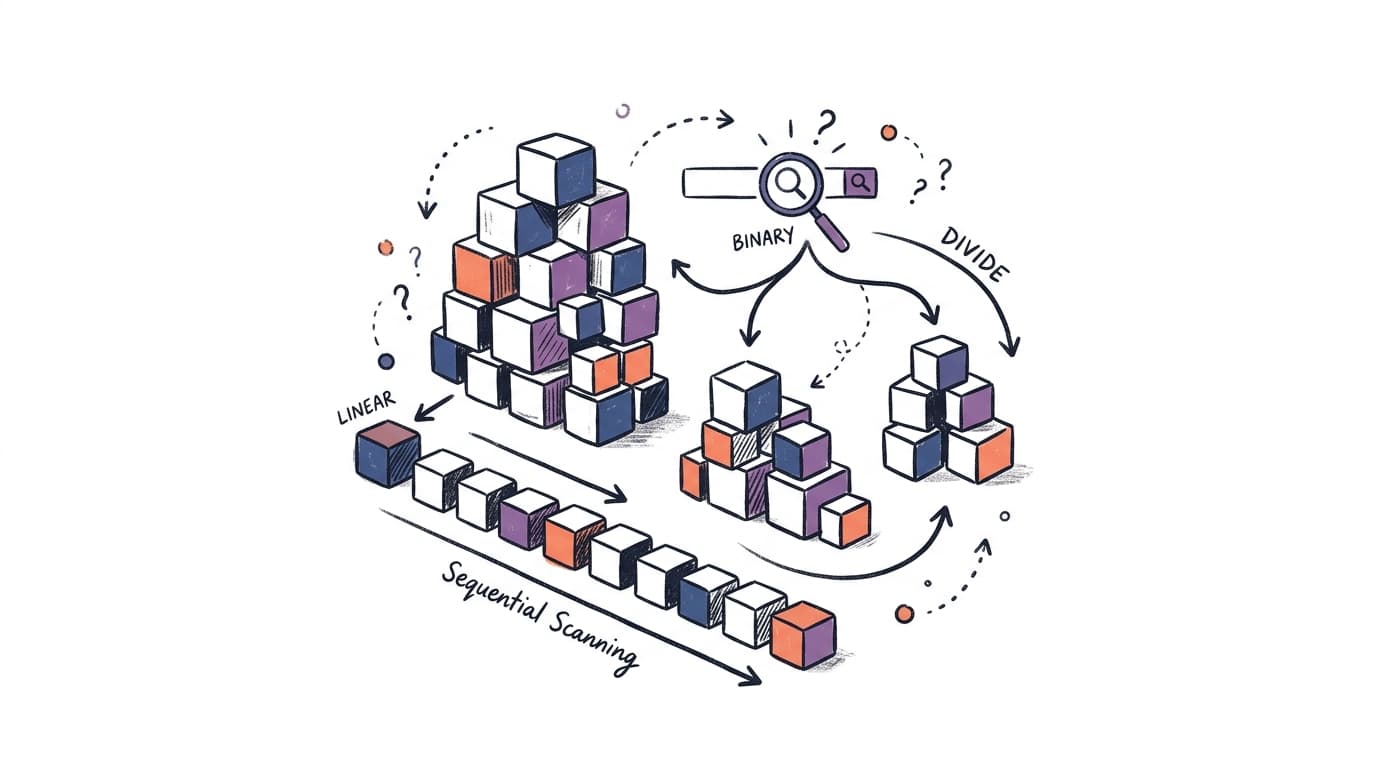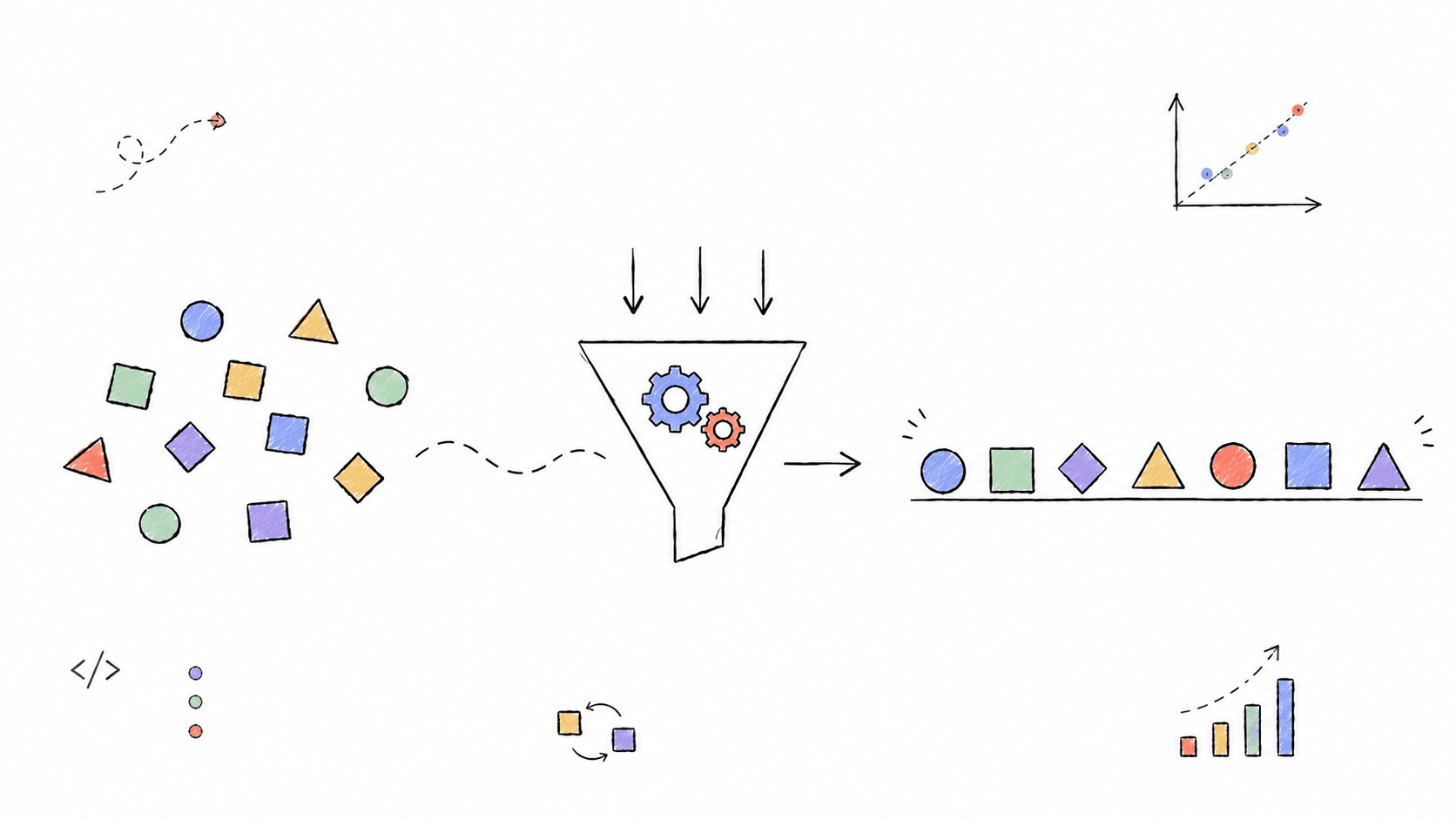
Sorting isn't just about order—it's about strategy. From the brute persistence of bubble sort, to the precision of insertion, and the divide-and-conquer elegance of merge and quick sort, every algorithm reveals a different way to think about structure, efficiency, and trade-offs.
Sorting is one of the most fundamental operations in computer science. It is the process of arranging data in a specific order, typically numerical or lexicographical. Sorting optimizes the efficiency of other algorithms (like binary search) that require input data to be in sorted lists.
In this guide, we'll explore four essential sorting algorithms ranging from elementary to advanced: Bubble Sort, Insertion Sort, Merge Sort, and Quick Sort.
While elementary algorithms like Bubble and Insertion sort are not the most efficient for large datasets, they are excellent for understanding the basic concepts of algorithm design. Advanced algorithms like Merge and Quick sort introduce the powerful "Divide and Conquer" paradigm.
01. Bubble Sort
Bubble Sort is a simple sorting algorithm that repeatedly steps through the list, compares adjacent elements, and swaps them if they are in the wrong order. The pass through the list is repeated until the list is completely sorted.
It gets its name because smaller (or larger) elements "bubble" to the top of the list during each iteration.
Complexity
| Metric | Complexity | Description |
|---|---|---|
| Best Time | When the array is already sorted. | |
| Average Time | When elements are in random order. | |
| Worst Time | When the array is reverse-sorted. | |
| Space | In-place sorting; no extra memory needed. |
Implementation (C++)
1#include <vector>2#include <utility>34void bubbleSort(std::vector<int>& arr) {5 int n = arr.size();6 bool swapped;78 for (int i = 0; i < n - 1; i++) {9 swapped = false;10 // Last i elements are already in place11 for (int j = 0; j < n - i - 1; j++) {12 if (arr[j] > arr[j + 1]) {13 std::swap(arr[j], arr[j + 1]);14 swapped = true;15 }16 }17 // If no two elements were swapped, array is sorted18 if (!swapped) break;19 }20}
Bubble Sort performs comparisons in the first pass, in the second, and so on. This reduction of the problem size by 1 in each step leads to the following relation:
Bubble Sort – Total Comparisons
Bubble Sort's complexity is derived from the sum of the number of comparisons made in each pass. In the first pass, we make comparisons, then , and so on, down to 1.
Visualizing Bubble Sort
Let's see Bubble Sort in action. Notice how the largest unsorted element continuously shifts to the rightmost available slot.
02. Insertion Sort
Insertion sort builds the final sorted array one item at a time. It iterates through the input array, consuming one input element per repetition, and grows a sorted output list.
Think of it like sorting a hand of playing cards: you pick up a card, find its correct position among the cards you are already holding, and insert it there.
Complexity
| Metric | Complexity | Description |
|---|---|---|
| Best Time | When the array is already sorted. | |
| Average Time | When elements are in random order. | |
| Worst Time | When the array is reverse-sorted. | |
| Space | In-place sorting; no extra memory needed. |
Implementation (C++)
1#include <vector>23void insertionSort(std::vector<int>& arr) {4 int n = arr.size();56 for (int i = 1; i < n; i++) {7 int current = arr[i];8 int j = i - 1;910 // Move elements greater than current to one position ahead11 while (j >= 0 && arr[j] > current) {12 arr[j + 1] = arr[j];13 j--;14 }15 arr[j + 1] = current;16 }17}
Similar to Bubble Sort, Insertion Sort takes an element and compares it with the already sorted subset (reducing the unsorted problem size by 1), resulting in:
Insertion Sort – Worst Case
In the worst case (a reverse-sorted array), for every element at index , we must compare and shift it with all elements to its left.
This summation is identical to Bubble Sort:
Visualizing Insertion Sort
Watch how Insertion Sort builds the sorted portion of the array sequentially on the left side.
03. Merge Sort
Merge Sort is a highly efficient, stable sorting algorithm based on the Divide and Conquer strategy. It works by recursively dividing the unsorted list into sublists, each containing one element, and then repeatedly merging sublists to produce new sorted sublists until there is only one sorted list remaining.
Complexity
| Metric | Complexity | Description |
|---|---|---|
| Best Time | Consistently halves the array. | |
| Average Time | Scales brilliantly with large datasets. | |
| Worst Time | Performance is guaranteed regardless of input. | |
| Space | Requires temporary arrays for the merging phase. |
Implementation (C++)
1#include <vector>23void merge(std::vector<int>& arr, int left, int mid, int right) {4 std::vector<int> temp(right - left + 1);5 int i = left, j = mid + 1, k = 0;67 while (i <= mid && j <= right) {8 if (arr[i] <= arr[j]) temp[k++] = arr[i++];9 else temp[k++] = arr[j++];10 }1112 while (i <= mid) temp[k++] = arr[i++];13 while (j <= right) temp[k++] = arr[j++];1415 for (int p = 0; p < k; p++) {16 arr[left + p] = temp[p];17 }18}1920void mergeSort(std::vector<int>& arr, int left, int right) {21 if (left >= right) return;2223 int mid = left + (right - left) / 2;24 mergeSort(arr, left, mid);25 mergeSort(arr, mid + 1, right);26 merge(arr, left, mid, right);27}
Merge Sort follows a perfect "Divide and Conquer" strategy, splitting the array into two equal halves and then performing a linear-time merge:
Merge Sort – Expansion Method
To find the complexity of Merge Sort, we expand the recurrence relation through substitution:
- Level 1:
- Level 2:
- Level 3:
- Level :
The recursion stops when , which means . Substituting back into the equation:
Visualizing Merge Sort
Observe how the algorithm groups smaller segments and zips them together into larger, sorted blocks.
04. Quick Sort
Quick Sort is another prominent Divide and Conquer algorithm. It works by selecting a "pivot" element from the array and partitioning the other elements into two sub-arrays, according to whether they are less than or greater than the pivot. The sub-arrays are then sorted recursively.
Despite having a worse theoretical worst-case time than Merge Sort, it is often faster in practice because its inner loop can be efficiently implemented on most architectures.
Complexity
| Metric | Complexity | Description |
|---|---|---|
| Best Time | When the pivot perfectly halves the array. | |
| Average Time | Expected time for randomized inputs. | |
| Worst Time | When the array is already sorted (if pivot is poorly chosen). | |
| Space | Call stack space for recursion. |
Implementation (C++)
1#include <vector>2#include <utility>34int partition(std::vector<int>& arr, int low, int high) {5 int pivot = arr[high]; // Choosing the last element as pivot6 int i = low - 1; // Index of smaller element78 for (int j = low; j < high; j++) {9 if (arr[j] < pivot) {10 i++;11 std::swap(arr[i], arr[j]);12 }13 }14 std::swap(arr[i + 1], arr[high]);15 return i + 1;16}1718void quickSort(std::vector<int>& arr, int low, int high) {19 if (low < high) {20 int pi = partition(arr, low, high);2122 // Recursively sort elements before and after partition23 quickSort(arr, low, pi - 1);24 quickSort(arr, pi + 1, high);25 }26}
In the average case (where the pivot splits the array into roughly equal halves), Quick Sort follows a relation identical to Merge Sort:
In the worst case (where the pivot is the smallest or largest element, such as in an already sorted array), the problem size only reduces by 1, making it as slow as Bubble Sort:
Quick Sort - Average Case Expansion
In the average case, where each partition splits the array into two roughly equal halves, the cost is represented by the sum of work at each level of the recursion tree. Since the tree depth is and the work at each level is :
Quick Sort – Worst Case Expansion
In the worst case, the pivot is always the smallest or largest element. This results in a highly unbalanced tree with a depth of . The work done is:
Visualizing Quick Sort
Notice how a pivot is chosen, and elements are physically thrown to the left or right of the pivot before recursing on those halves.
Comparison Summary Table
| Algorithm | Recurrence () | Expansion Form | Closed Form |
|---|---|---|---|
| Bubble | |||
| Insertion | |||
| Merge | |||
| Quick (Avg) | |||
| Quick (Worst) |
Conclusion
Understanding these sorting algorithms is a crucial milestone in mastering data structures and computer science fundamentals.
- Use Bubble/Insertion sort when dealing with tiny datasets or nearly-sorted data.
- Use Merge sort when you need a guaranteed stable sort and have memory to spare.
- Use Quick sort for standard, highly optimized, in-place sorting on general data.
Keep practicing and analyzing their visual behaviors to build an intuitive understanding of how these algorithms manipulate memory in real-time!
Here are the formal recurrence relations for each of the sorting algorithms, formatted in the exact style you requested. You can drop these directly into your MDX document.